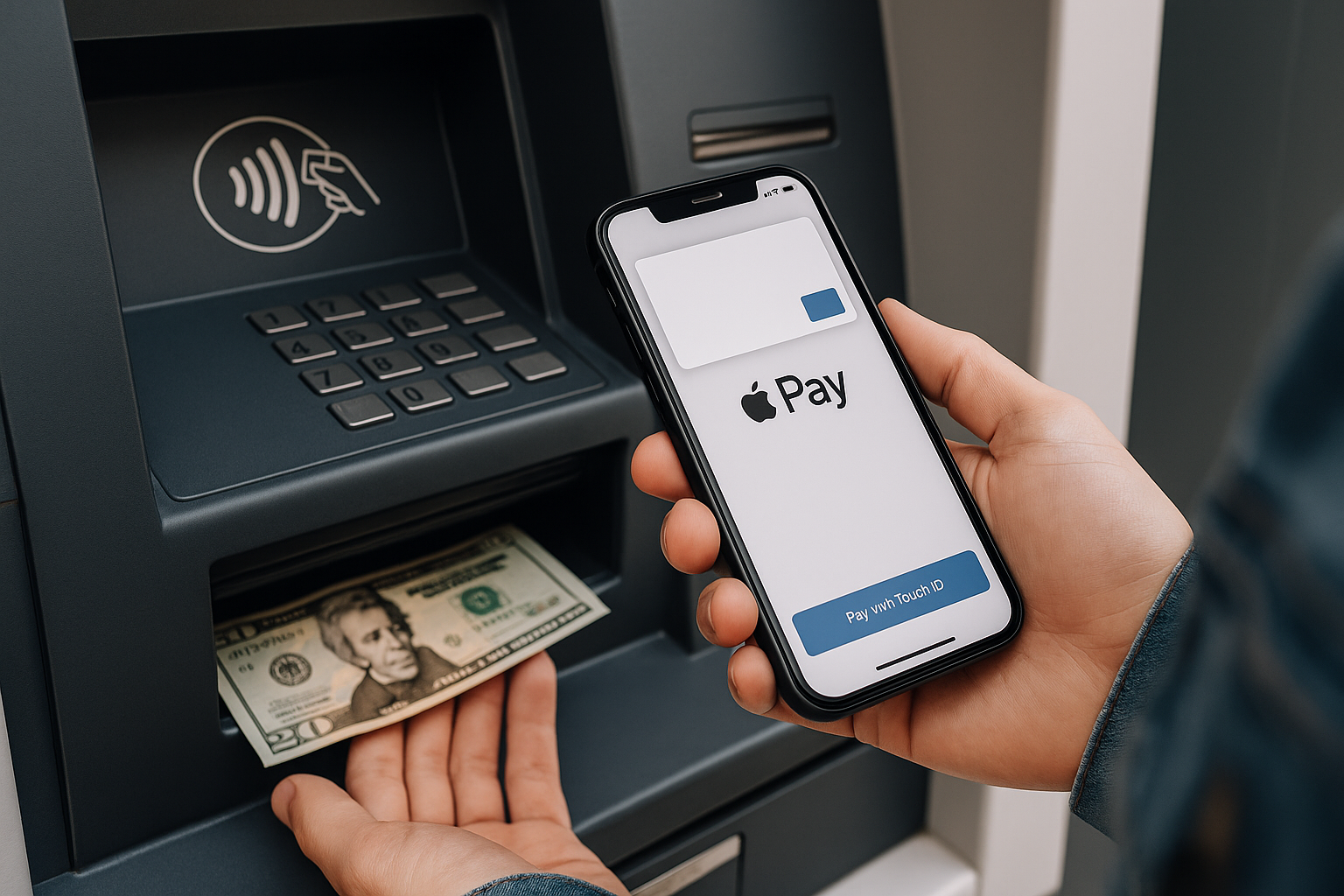
You can withdraw cash from many ATMs using Apple Pay or Google Pay instead of a physical debit card. This contactless option works at supported machines nationwide and allows you to access cash using your phone, biometric authentication, and your bank’s mobile wallet setup.
This guide explains how Apple Pay and Google Pay ATM withdrawals work, which banks support them, what to expect at the machine, and what to do if a digital wallet withdrawal doesn’t work.
How Apple Pay and Google Pay Work at ATMs
Apple Pay and Google Pay use near-field communication (NFC) technology, the same contactless system used at retail checkout terminals. At compatible ATMs, your phone securely transmits a temporary token instead of your actual card number.
If an ATM displays the contactless symbol, it may support digital wallet withdrawals. Instead of inserting a card, you authenticate using your phone and complete the transaction directly at the machine.
- Hold your phone near the ATM’s NFC reader.
- Authenticate using Face ID, fingerprint, or passcode.
- Select your account and withdrawal amount.
- Confirm and collect your cash.
What You Need Before Using a Digital Wallet ATM
Before attempting a wallet-based ATM withdrawal, make sure the following are in place:
- Your debit card is added and verified in Apple Pay or Google Pay.
- Your bank supports cardless or contactless ATM withdrawals.
- The ATM has an active NFC reader.
- Your phone has battery power and an internet connection.
Some banks require you to enable cardless access inside their mobile app before using a digital wallet at an ATM.
Banks That Support Apple Pay and Google Pay ATM Withdrawals
Many large U.S. banks support digital wallet ATM withdrawals at select locations. Availability can vary by region and by ATM model.
- Chase: Supports Apple Pay and Google Pay through Chase Cardless Access at many Chase ATMs.
- Wells Fargo: Allows contactless withdrawals at ATMs with NFC readers.
- Bank of America: Supports Apple Pay, Google Pay, and Samsung Pay at enabled ATMs.
- Capital One: Offers mobile wallet withdrawals at select machines.
- U.S. Bank: Supports contactless ATM access at participating locations.
Not every ATM owned by these banks supports digital wallets, so checking your bank’s ATM locator before visiting is recommended.
Apple Pay vs Google Pay at ATMs: What’s the Difference?
From a user perspective, Apple Pay and Google Pay work similarly at ATMs. Both rely on NFC, biometric authentication, and tokenization to secure transactions.
- Apple Pay: Uses the Wallet app on iPhone with Face ID or Touch ID authentication.
- Google Pay: Uses Google Wallet on Android devices with fingerprint or PIN verification.
The main differences depend on your bank’s implementation rather than the wallet itself.
Withdrawal Limits and Fees
Digital wallet ATM withdrawals usually follow the same daily limits and fee rules as physical debit card withdrawals. However, some banks apply lower per-transaction caps to cardless withdrawals.
- Daily ATM withdrawal limits still apply.
- Out-of-network ATM fees may still be charged.
- Some ATMs limit the maximum amount per cardless transaction.
For a broader explanation of cardless withdrawal limits, see our guide on withdrawing cash without a card.
When Apple Pay or Google Pay ATM Withdrawals Don’t Work
Digital wallet withdrawals can fail for several reasons, even if your bank supports them.
- The ATM’s NFC reader is disabled or out of service.
- Your bank has temporarily restricted cardless access.
- You’ve reached your daily withdrawal limit.
- The ATM is offline or cannot contact your bank.
If your transaction is declined, avoid repeated attempts at the same ATM. Switching machines or contacting your bank is often the fastest solution.
Security Benefits of Digital Wallet ATM Withdrawals
Using Apple Pay or Google Pay at an ATM reduces exposure to card skimming and theft. Your actual card number is never shared with the ATM, and each transaction requires biometric or device-level authentication.
For additional safety guidance, review our ATM security tips.
When You Should Still Carry a Debit Card
While digital wallets are convenient, not all ATMs support contactless withdrawals. Rural areas, older machines, and smaller banks may still require a physical card. Carrying a debit card as a backup is recommended when traveling or during emergencies.
Bottom Line
Apple Pay and Google Pay make it possible to withdraw cash from many ATMs without using a physical debit card. As cardless technology expands, digital wallets offer a faster and more secure way to access cash — as long as you know which ATMs support it and keep a backup option available.